Building climate risk into fisheries management
- Adaptation story
Australia’s Commonwealth-managed fisheries stretch from the tropical north to the Southern Ocean, representing an enormous span of ocean, and a large range of climate risks. As ocean temperatures, currents and marine ecosystems change, fisheries managers increasingly need to consider how those changes could affect fish stocks alongside the usual biological and fishing pressures.
The Australian Fisheries Management Authority (AFMA) has been working with CSIRO, IMAS and the Fisheries Research and Development Corporation to understand these risks and how fisheries management can respond. Climate sensitivity assessments have now been completed for more than 100 species occurring in Commonwealth fisheries, with modelling used to explore how some stocks could change by 2050. The results show that every Commonwealth fishery contains species that are sensitive to climate change, and that many fisheries are likely to become more variable in the future.
The challenge is turning that science into something managers can use when making real fisheries decisions. In 2022, the AFMA Commission agreed that climate change should be considered in Resource Assessment Group and Management Advisory Committee discussions where catch or effort advice is being developed. Climate and Ecosystem Status Reports were subsequently developed to provide fishery-specific information on recent environmental conditions, ecosystem indicators and seasonal forecasts.
These reports are now produced for a growing number of Commonwealth fisheries, from the Northern Prawn Fishery and Torres Strait fisheries to the Bass Strait Central Zone Scallop Fishery and the Southern and Eastern Scalefish and Shark Fishery. They provide managers and industry with a regular picture of what is happening in the ocean around a fishery, rather than requiring climate information to be brought together from scratch when conditions become unusual.
Importantly, this information is not simply being reported, it is being brought into management discussions. For example, when a severe marine heatwave was forecast for summer 2023–24, the Climate and Ecosystem Status Report for the Bass Strait Central Zone Scallop Fishery prompted discussion about whether the fishery’s Total Allowable Catch was sufficiently conservative given the potential impacts of the heatwave. The reports did not determine the decision on their own, but they provided climate information that could be considered alongside the other evidence used in fisheries management.
AFMA has now taken this one step further. Following trials during 2024 and 2025, it completed a Climate Risk Framework in October 2025. The framework provides a repeatable four-step process for assessing climate-driven risks to species, considering whether existing management or industry measures are sufficient, and identifying whether additional measures are needed. AFMA says the framework is now being implemented across all Commonwealth-managed fisheries, with climate risk assessments integrated into existing advisory and decision-making processes.
What makes this an adaptation story is the change in how climate risk is handled. Rather than relying on climate information only when an extreme event occurs, AFMA is building climate considerations into the routine processes used to manage fisheries. It is an example of adaptation happening not through a new piece of equipment or a change on a fishing vessel, but through a change to the way decisions are made.
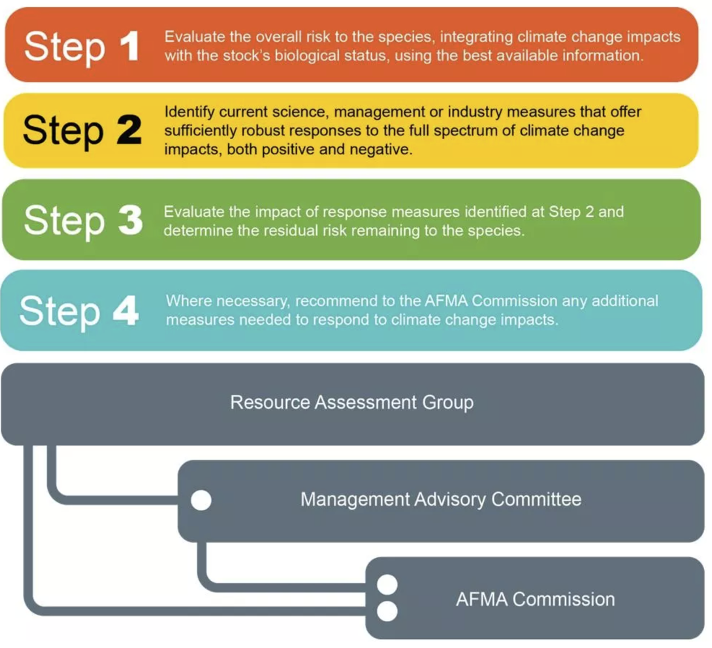
Figure: AFMA Climate Risk Framework to Formally integrate climate risks into management decisions for Commonwealth-managed fisheries