Heat Stress Impacts
QUESTION
With climate change, how will heat stress affect the workforce in Northern Australia?
ANSWER 1
By: Dr Beth FultonNorthern Australia is very likely to be hard hit by increases in temperature under climate change. Its workers already operate close to safe heat limits at times and every extra bit of warming will cut the hours they can safely do physical work. Most heavy outdoor work in the north, such as construction, maintenance and mining, is packed into the dry season. Fishing may well have to join them (or switch to fishing at other times of the day as is already done in the Pacific Islands).
Heat stress scientists are already warning that the workable season is getting shorter and warmer, which squeezes the window for safe work. Medical research in the last few years looking at outdoor workers in Darwin and Townsville found that body temperatures already go above the 38°C safety threshold in today’s climate and by mid-century, safe work durations will fall by 20–50%.
Heat is also already causing illness and productivity losses across Northern Australia (and Australia more generally). A survey of labour-intensive workers in the North run about 6 years ago found 79% reported chronic heat symptoms (cramps, rashes, headaches, fatigue) and 47% reported severe symptoms that match heat exhaustion (and some heat stroke). Between 30% and 60% said heat hurt their work performance and home life. Air-conditioning cut chronic symptoms by about half but that is not possible in outdoor labour-intensive jobs. Nationally, lost productivity due to heat already costs the nation about US$6.2 billion a year, with about 70% of workers slowing through down through the hottest couple of weeks a year and around 7% actually having to take a week a year to deal with heat related issues. The National Climate Risk Assessment for Australia (2025) projects these productivity losses to grow to $200–400 billion or more by around 2050-2060. As temperatures rise with climate change the number of severe and extreme heatwave days also grow – likely doubling or trebling by 2050-2070. With the levels of warming possible if emissions remain high, heat deaths in places like Townsville and Darwin could rise by about 300-400% or more.
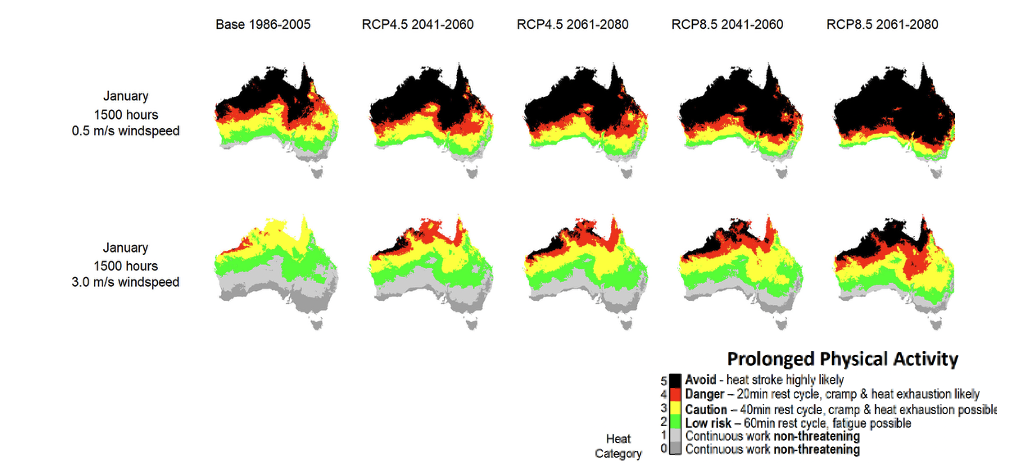
The attached image is from a scientific publication (reference at the bottom of the page) looking at a heat-stress index called wet bulb globe temperature (WBGT) – which combines to air temperature, humidity, sunshine and wind. This index was originally created by the US army to know when it was safe for different working levels by their soldiers. The associated work–rest guidance is set in five heat categories, and category 5 (above 32.2°C) is the highest where continuous hard becomes physically dangerous. You can see that on a still day that northern Australia already has restricted outdoor work over large areas. Once a mild breeze is present that threat begins to drop and longer periods of work are possible. As temperatures climb with warming the level of relief is lower and some regions well remain in those harsh conditions. The good news is that options do exist, with early morning work possible (e.g. around 6am) for much of the year except under the highest warming scenarios (when working limits would stretch all day long in the hottest months of the year) and mid-year conditions also conducive to outside work. So it will be a matter of shifting when and what you do rather than abandoning things altogether.
Heat stress science is advancing all the time and there are apps to help you check conditions locally. While originally developed for sporting activities the “Sports Heat Tool” was developed for Australian conditions. Fishing in the app represents recreational fishing so if commercial fishing you would most likely want to pick a more rigorous sport to judge the heat stress risk. However it can be a useful guide to current and upcoming conditions.
More information on what heat stress is and what can be done can be found at
https://sma.org.au/wp-content/uploads/2009/05/beat-the-heat.pdf
And the Bureau of Meteorology has a page on how they report heat stress (thermal comfort) at https://www.bom.gov.au/info/thermal_stress/
Reference:
Hall et al (2022) Spatial analysis of outdoor wet bulb globe temperature under RCP4.5 and RCP8.5 scenarios for 2041–2080 across a range of temperate to hot climate. Weather and Climate Extremes 35 (2022) 100420
Supporting gallery:
Answered by: