Demographic and cultural drivers of fishing and adaptation
QUESTION
How do changing demographics and cultural practices influence fishing behaviour and climate adaptation?
ANSWER 1
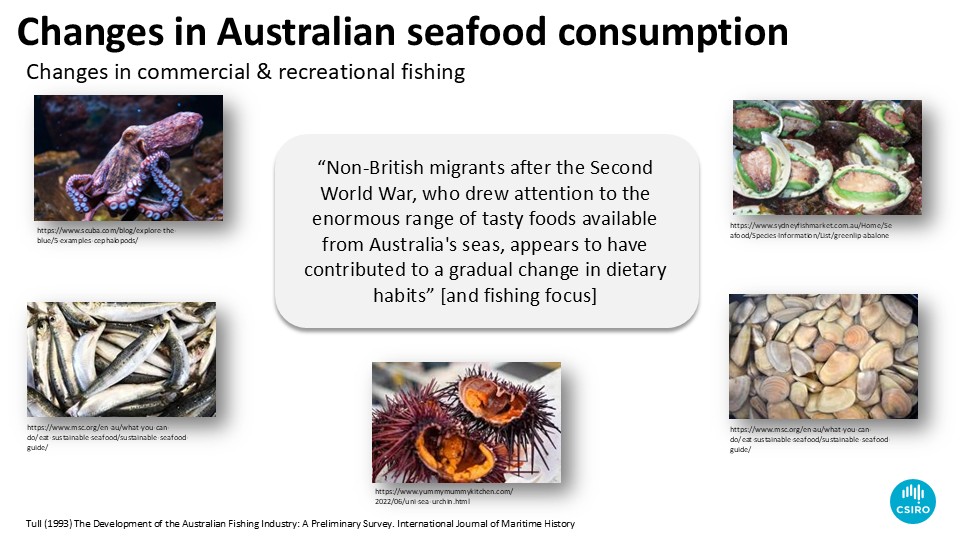
By: Dr ingrid van PuttenThere is a bit of evidence that changing demographics changes fishing behaviour. In particular, that new waves of immigration to Australia in the past 100 years has brought with it new preferences for different fish. Italian and Greek migrants brought with them fishing knowledge and a love of cephalopods of all descriptions. At the time, squid, cuttlefish, and octopus were used by Australians as bait at best and fertiliser at worst. Modern Asian migrants have a fondness for tropical fish (Barramundi, Mangrove Jacks, and Spanish Mackerel) and molluscs. Familial connections were used to establish exports (benefitting the fishing industry). “Non-British migrants after the Second World War, who drew attention to the enormous range of tasty foods available from Australia’s seas, appears to have contributed to a gradual change in dietary habits” and fishing focus [from Tull (1993) The Development of the Australian Fishing Industry: A Preliminary Survey. International Journal of Maritime History]. The management implication are also evident (e.g. localised depletion, potential for conflict, health hazards, communication challenges).
In general, there is not much academic research into the topic (cultural aspects of recreational fishing) – mainly anecdotal. But historically the influence of culture on recreational fishing, commercial fishing, and food preferences is evident in Australia.
I am not able to answer the second bit of the question (how demographics and cultural practices influence climate adaptation but this article might be of interest Climate change adaptation needs a science of culture – PMC and this one The role of culture and traditional knowledge in climate change adaptation: Insights from East Kimberley, Australia – ScienceDirect
Supporting gallery:
Answered by: