Climate change predictions vs reality
QUESTION
Researchers in climate change seem to focus on predictions, e.g. the globe will be XºC warmer by Y year. Is there a plan to compare predictions to reality? How do we measure, and how do we know, if the predictions they are making are coming true and if the predicted climate change is actually happening?
ANSWER 1
By: Dr Alistair HobdayThat’s a question I always want answered too, but first some important language to explain. There is a difference between a prediction (for a single outcome) and a projection (what might happen), as explained in this table below. Climate scientists use climate models to make projections, and I will use that language in my answer.
| Prediction | Projection – made by climate models |
|---|---|
| Estimates what will happen. | Estimates what would happen if certain assumptions are true. |
| Can be tested against a single future outcome. | Different projections correspond to different futures. |
| Example: “Global temperature will increase by 2.3°C by 2100.” | “If emissions follow SSP2-4.5, global temperature is projected to increase by about 2.7°C by 2100.” |
Now to the answer. Comparing projections to observations is a major part of climate science. Climate models are not simply used to make projections and left untested. Researchers routinely compare past projections against observed temperatures, sea level rise, sea ice extent, ocean heat content, precipitation patterns, and many other variables. The IPCC reports have entire chapters devoted to model evaluation. Obviously, you can only compare projections to data collected since the projection was made, but that comparison period can be up to 20 years for some projections (e.g. made in 2005 and compared up to the year 2025). A widely-cited study led by Zeke Hausfather (in 2020) found that most historical climate model projections were remarkably accurate when evaluated against the greenhouse gas emissions and forcing that actually occurred. – Study Confirms Climate Models are Getting Future Warming Projections Right – NASA Science
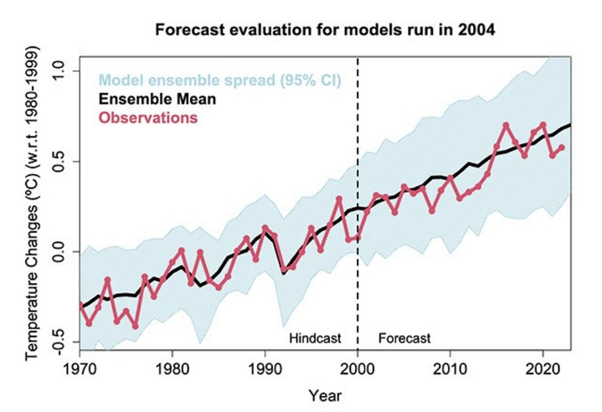
For example, the figure below shows projections for the next 20 years. The models were run in 2004, but the modellers ran the projection (forecast) from the year 2000. The projection does a good job of matching the observed data (ensemble mean).

Climate scientists also run models for the 20th century with and without greenhouse gas forcing and see which model best matches the observed data. These analyses have shown that you cannot get the observed warming without including the human influence on the planet.
Interestingly, if humans change their behaviours and greenhouse gas emissions are reduced, then some of the worst projections for temperature rise will not come true. That’s good news, and in earlier this year the climate-scenario community that develops the emissions pathways used by the IPCC concluded that high global warming scenario RCP8.5 (and its CMIP6 successor SSP5-8.5) is no longer a plausible future. These scenarios have been dropped from the new CMIP7 scenario framework that will underpin IPCC AR7.
Ultimately, I hope that many of the long-term predictions, made in say 2000 or 2010, do not occur. This will be because additional decisions made by governments around the world really reduce the greenhouse gas emissions and global warming due to human activities.
Additional reading
Hausfather, Z., H. F.Drake, T. Abbott and G. A.Schmidt (2020). Evaluating the Performance of Past Climate Model Projections. Geophysical Research Letters 47: e2019GL085378. https://doi.org/085310.081029/082019GL085378.
Supporting gallery:
Answered by: