Fishing for better climate information
- Adaptation story
- New South Wales
Our ability to adapt to climate change is only as good as our understanding of how our environment is changing. For Australia’s fishing industry, a growing ocean-observing program is putting that principle into practice by turning fishing vessels into ships of opportunity for ocean science.
Australia’s commercial fishing fleet spends thousands of hours at sea each year, regularly deploying fishing gear through the water column. FishSOOP – the Fishing Vessels as Ships of Opportunity Program – is making use of that opportunity to collect valuable information about what is happening beneath the ocean surface.
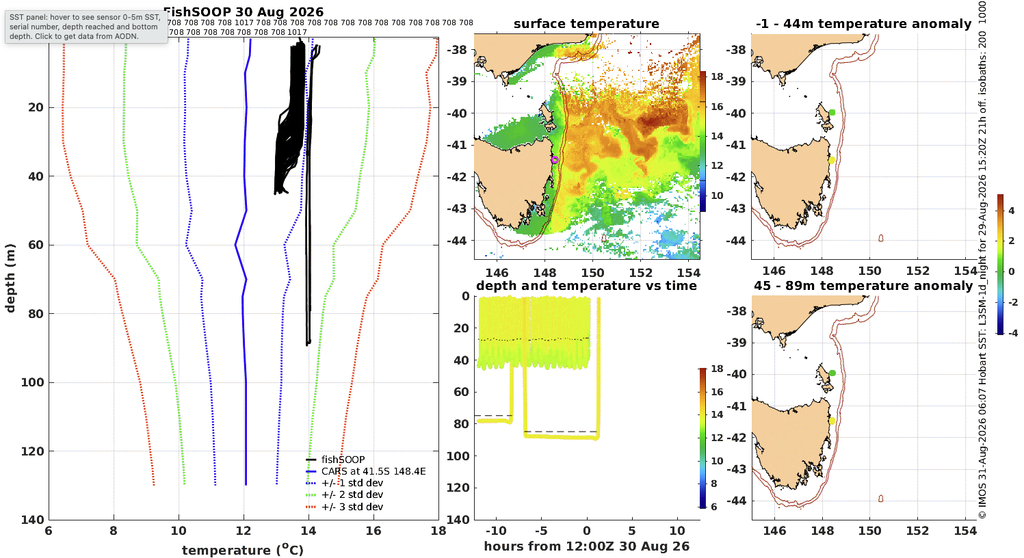
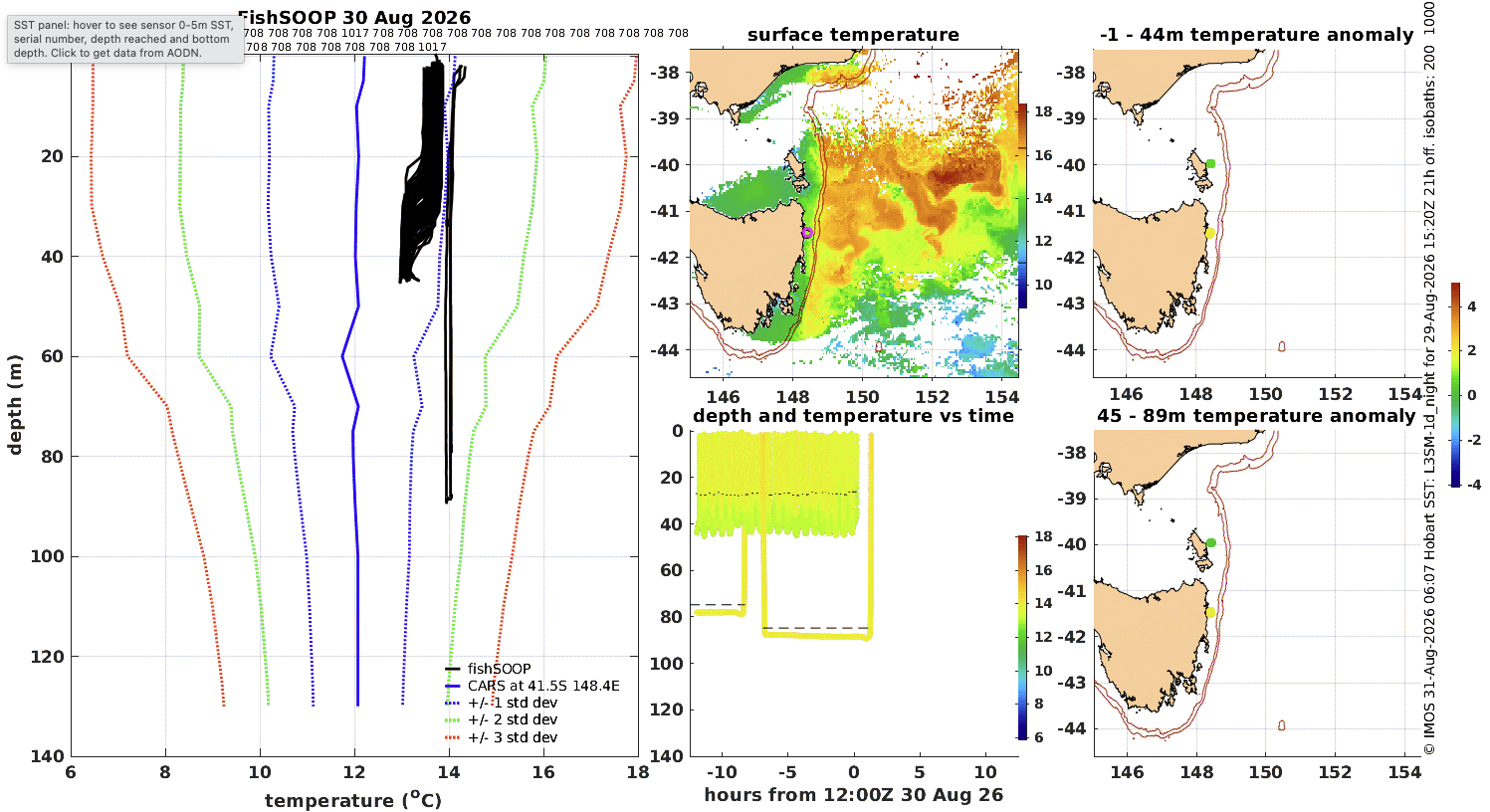
FishSOOP is a collaboration between commercial fishers, Fishwell Consulting, the University of New South Wales (UNSW) and Australia’s Integrated Marine Observing System (IMOS). Small Moana temperature-depth sensors are attached to fishing gear, where they record the temperature and depth of the water as the gear is deployed. The observations are associated with the time and location of each deployment and transmitted from the vessel to cloud storage via a deck-based unit. The data are quality controlled and identifying vessel information is removed before being made available through the Australian Ocean Data Network.
Why do we need data from beneath the surface?
We already have extensive information about sea surface temperature, including measurements collected by satellites. But knowing what is happening at the surface does not necessarily tell us what is happening deeper in the water.
This is particularly important in a changing climate. The waters of south-eastern Australia are a global ocean-warming hotspot, with surface temperatures in some areas increasing at close to four times the global average rate. The southward extension of the East Australian Current is contributing to major changes in ocean conditions along Australia’s east coast.
Understanding these changes requires observations throughout the water column. Traditionally, collecting subsurface observations has required research vessels, moorings, autonomous platforms or other specialised oceanographic equipment.
Commercial fishing vessels provide another option.
Because fishers are already putting gear into the water, sensors can collect observations as part of normal fishing activity. This allows FishSOOP to gather measurements in places and at times that would otherwise be difficult and expensive for scientists to reach.
The approach has already generated millions of observations. During the initial trial, participating vessels collected more than three million data points from more than 12,500 fishing sets, including observations from some of Australia’s most remote regions where there had previously been little or no subsurface ocean data.
Filling the gaps in our picture of the ocean
FishSOOP observations complement other ocean-observing systems, including satellites, buoys, gliders and other profiling instruments.
Together, these different observing systems help scientists build a more complete picture of Australia’s changing oceans.
FishSOOP is particularly valuable because the observations are collected where fishing is actually taking place, including across continental shelf and upper-slope waters that can be difficult to observe consistently using other methods. The data can help scientists understand ocean circulation, temperature changes and the development and movement of marine heatwaves.
The information can also be used to improve ocean models and forecasts, giving researchers and fisheries managers a better understanding of the environmental conditions that influence fisheries.
But there is another important part of the program: the data also go back to the fishers.
From ocean observation to real-time adaptation
FishSOOP data can be returned to participating vessels in near real time. This means fishers can see temperature-at-depth information from the waters they are working in, providing another source of information to help guide fishing decisions and potentially reduce wasted time and fuel.
A particularly relevant example occurred during a marine heatwave in January and February 2024.
A longline tuna vessel participating in FishSOOP was fishing in the northern part of the East Australian Current during an extensive marine heatwave. Cloud cover limited satellite observations of sea surface temperature, but the sensor attached to the vessel’s fishing gear continued to provide observations below the surface.
The sensor recorded temperatures above 28°C down to 80 metres. As the vessel moved approximately 500 kilometres south, the FishSOOP observations showed the changing temperature structure through the water column and the vessel eventually reached considerably colder waters. The near-real-time information helped the fishers adjust where and at what depth they deployed their fishing gear in response to changing ocean conditions.
Rather than simply responding to climate change after its impacts are felt, fishers can use information about changing ocean conditions to make decisions while they are at sea.
A two-way benefit
FishSOOP demonstrates the value of bringing industry and science together to solve a problem that neither could address as effectively alone.
For researchers, fishing vessels provide a cost-effective way of collecting observations across large areas of Australia’s marine environment. Those observations help fill gaps in existing datasets, improve models and build our understanding of changing ocean conditions.
For fishers, the same observations provide information that can help them understand the environmental conditions influencing their fishing grounds and make more informed decisions about where and how they fish.
The result is a two-way flow of information: fishers contribute observations that improve our understanding of the ocean, while scientists return information that can help fishers respond to a changing ocean.
That collaboration is particularly important as climate change alters the conditions in which Australia’s fisheries operate.
What does this mean for climate adaptation?
Climate adaptation is not just about changing what we do. It is also about improving the information we use to make decisions.
FishSOOP shows how existing industry activity can become part of the climate-observing system, creating new information without requiring every observation to come from a dedicated research vessel.
As Australia’s oceans continue to warm and marine heatwaves become an increasingly important challenge for fisheries, having timely information about what is happening beneath the surface will become increasingly valuable.
Successful adaptation requires researchers, industry and managers to work together to understand how our oceans are changing and what those changes mean for Australia’s seafood sector. FishSOOP is a great example of that approach in action.
Here at Sea Change Australia, we are interested in sharing examples of practical approaches that can help Australia’s seafood sector understand, prepare for and respond to climate change.
The FishSOOP data are quality controlled and made publicly available through the Australian Ocean Data Network (AODN). The OceanCurrent interface allows users to explore daily and regional observations, including temperature, depth and temperature anomalies from locations around Australia.
Explore FishSOOP data:
FishSOOP data – Australian Ocean Data Network
Read more about FishSOOP and the research behind the program:
FRDC: FishSOOP solving ocean data issues
Fishing for Ocean Data in the East Australian Current