Climate Mitigation and Adaptation in Blue Food Systems
- News item
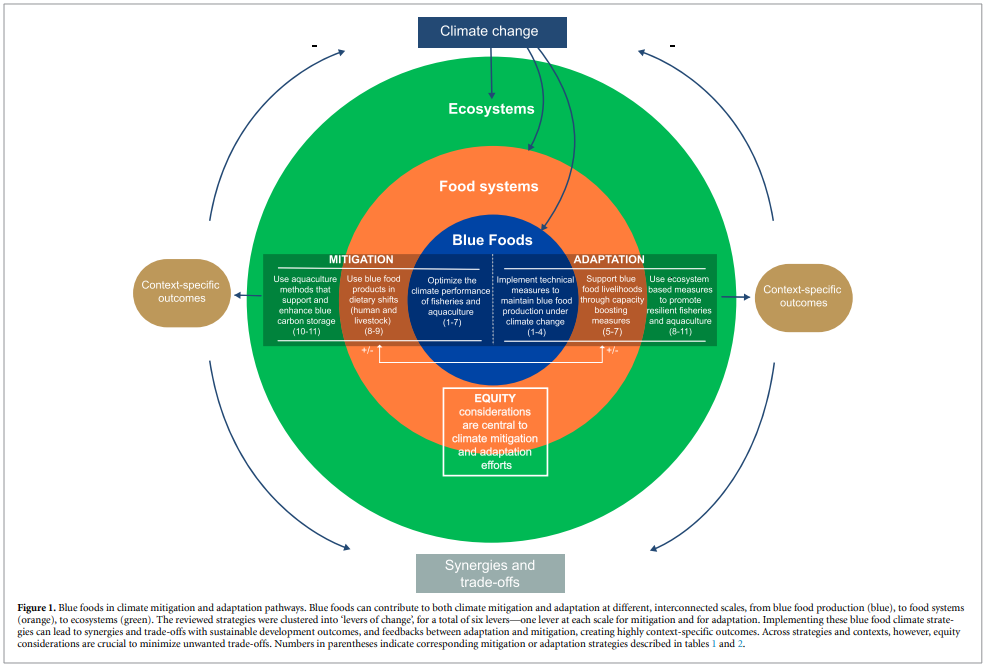
Blue food systems, including aquatic organisms such as fish, shellfish, and aquatic plants harvested from oceans and freshwater, have a critical role to play in climate change mitigation and adaptation.
Compared to most land-based animal proteins, blue foods typically have a much smaller carbon footprint, making them an important part of the global food system’s response to climate change.
A major new scoping review published in Environmental Research: Food Systems has reviewed 22 strategies for reducing emissions and building climate resilience in these systems.
Led by researchers at the University of British Columbia, Stockholm University, WorldFish, and Stanford University, the study explored the feasibility, co-benefits, and trade-offs of climate mitigation and adaptation strategies in blue food systems
The authors found that blue foods offer genuine climate opportunities. The strongest evidence was for two mitigation approaches: decarbonising fishing and aquaculture production (through fuel-efficient vessels, renewable energy, and better fisheries management), and shifting diets toward low-emission blue foods like small pelagic fish and bivalves.
As an adaptation strategy, switching fishing gear or target species showed the most promise.
However, no single strategy is transformative on its own. Nearly all strategies involve trade-offs, particularly for food security, biodiversity, and equity. This is especially true for small-scale and marginalised fishing communities, who tend to bear the greatest climate risks but have the least access to resources and decision-making. The authors recommend portfolios of complementary, locally-led strategies rather than any one-size-fits-all fix.
Figure from Aleah Wong et al 2026 Environ. Res.: Food Syst. 3 035007
At Sea Change Australia, we’re passionate about the role seafood can play in a sustainable future. We’d love to hear your thoughts. Please reach out and join the conversation.