Changes in size of barracouta and the relationship to climate
QUESTION
The east coast of Tasmania used to have lots of large barracouta which were readily caught recreationally, however more recently it’s been observed that the barracouta are smaller and less numerous. Is this observation related to climate change, and how might climate change impact barracouta populations?
ANSWER 1
By: Dr Alyssa MarshellAre smaller barracouta linked to climate change?
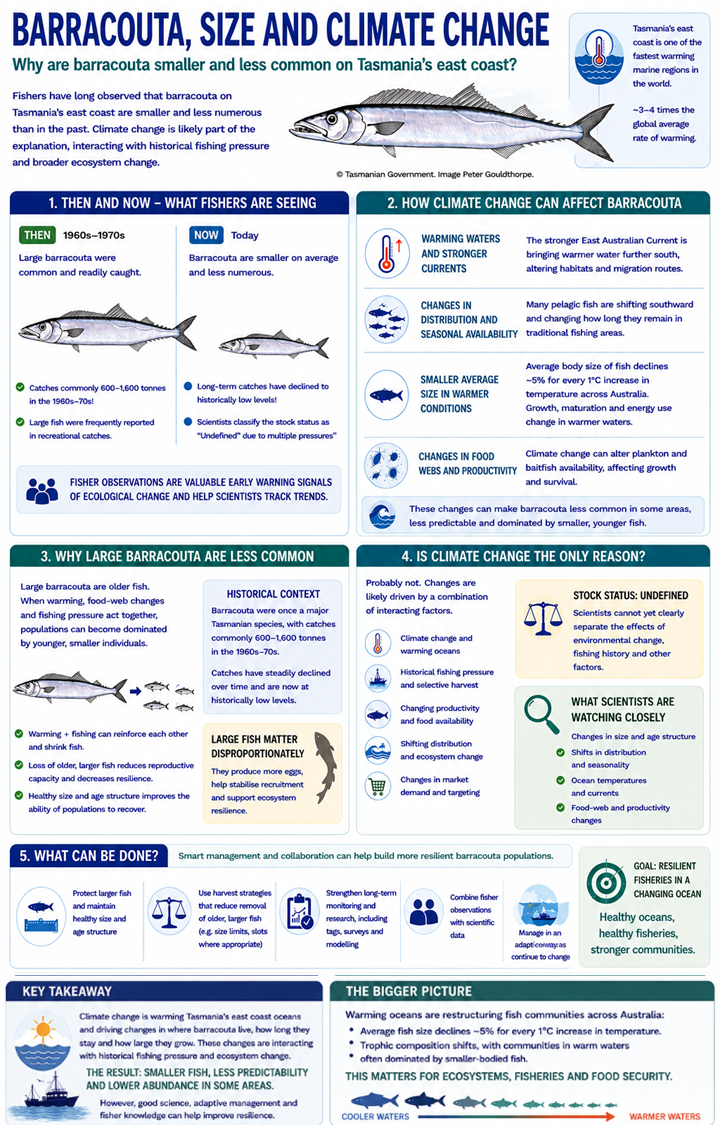
Many Tasmanian fishers have noticed that barracouta are not as large or abundant as they once were. Historical records support this observation. Barracouta were once a major Tasmanian fishery species, with catches commonly reaching 600–1,600 tonnes during the 1960s and 1970s, but catches have declined substantially over time.
Climate change is likely part of the explanation, but probably not the only reason. Scientists currently think the changes are likely driven by a combination of:
- warming ocean conditions,
- changing currents,
- shifts in food availability,
- historical fishing pressure,
- and broader ecosystem change.
Why could climate change matter?
Tasmania’s northeast coast is one of the fastest warming marine regions in the world. A major driver is the strengthening East Australian Current, which is bringing warmer water further south than historically experienced. Barracouta are highly mobile fish that are strongly influenced by ocean conditions. Climate change may affect them in several important ways.
Smaller fish in warmer waters
Research from around Australia shows that reef fish communities generally become smaller in warmer waters. A recent study analysing \~15,000 fish surveys found that average fish body length declined by about 5% for every 1°C increase in ocean temperature. There are several possible reasons for this:
- fish may grow faster when young but mature earlier at smaller sizes,
- warmer conditions can increase stress and energy demands,
- and changing food webs may reduce the ability of fish to reach older, larger sizes.
This pattern has been observed globally in many marine species and is often called the “temperature-size rule.”
Changing distribution and seasonal availability
Climate change may also be shifting where barracouta occur and how long they remain in Tasmanian waters. Studies from eastern Australia show that warming oceans are already causing many fish species to shift southward and change their seasonal distribution patterns. For fishers, this can appear as:
- fewer fish in traditional fishing areas,
- shorter seasonal runs,
- or fish becoming less predictable to catch.
Importantly, fish may not completely disappear, but they may spend less time in the same places or move further offshore.
Why are large barracouta less common?
Large barracouta are older fish. If warming oceans, changing food availability, and fishing pressure all act together, populations can become dominated by younger and smaller individuals. Recent research suggests climate change and fishing pressure can reinforce each other. Warming can reduce average fish size, while fishing can remove older age classes that help populations remain resilient.
Large, older fish are especially important because they often produce more eggs and help stabilise recruitment during poor environmental years.
Is climate change the only explanation?
Probably not. The current barracouta stock status in Tasmania is classified as “Undefined” because scientists cannot yet clearly separate the effects of:
- environmental change,
- historical fishing impacts,
- and changing fishing behaviour or market demand.
Marine ecosystems are complex, and multiple pressures are likely interacting at the same time. This is why fisher observations are so valuable. Long-term local knowledge can provide early warning signs of ecosystem change before they are fully captured in scientific monitoring programs.
What can be done?
There are practical ways to improve resilience in changing oceans:
- maintain healthy age and size structure,
- protect larger breeding fish,
- continue long-term monitoring,
- and combine fisher observations with scientific research.
Adaptive fisheries management becomes increasingly important as climate variability increases.
Key takeaway
The decline in large barracouta on Tasmania’s east coast is likely linked partly to climate-driven warming and changing ocean conditions, but climate change is probably interacting with fishing pressure and broader ecosystem change. The good news is that Australia has strong fisheries science and monitoring programs, and fishers themselves play a critical role in identifying environmental change. Combining scientific research with fisher knowledge will be essential for understanding and adapting to future changes in barracouta populations.
Watch – amazing footage of historical Barracouta fishing In Tasmania: https://www.youtube.com/watch?v=77wXFjzrJes
References
Audzijonyte, A., Richards, S.A., Stuart-Smith, R.D., Pecl, G., Edgar, G.J., Barrett, N.S., et al. 2020. Fish body sizes change with temperature but not all species shrink with warming. Nature Ecology & Evolution 4: 809–814.
Coghlan, A.R., Blanchard, J.L., Wotherspoon, S., Stuart-Smith, R.D., Edgar, G.J., Barrett, N., & Audzijonyte, A. 2024. Mean reef fish body size decreases towards warmer waters. Ecology Letters 27: e14375.
Edgar, G. J., Stuart-Smith, R. D., Heather, F. J., Barrett, N. S., Turak, E., Sweatman, H., … & Bates, A. E. (2023). Continent-wide declines in shallow reef life over a decade of ocean warming. Nature, 615(7954), 858-865.
Pecl, G.T., Araújo, M.B., Bell, J.D., et al. 2017. Biodiversity redistribution under climate change: impacts on ecosystems and human well-being. Science 355: eaai9214.
Robinson, L. M., Gledhill, D. C., Moltschaniwskyj, N. A., Hobday, A. J., Frusher, S., Barrett, N., … & Pecl, G. T. (2015). Rapid assessment of an ocean warming hotspot reveals “high” confidence in potential species’ range extensions. Global Environmental Change, 31, 28-37.
Sharples et al (2025) TASMANIAN SCALEFISH FISHERY ASSESSMENT 2023/24, IMAS report 195 pages; https://www.utas.edu.au/__data/assets/pdf_file/0011/1894961/Scalefish-Assessment_2023-24.pdf
van Rijn, I., Buba, Y., DeLong, J., Kiflawi, M., & Belmaker, J. 2017. Large but uneven reduction in fish size across species in relation to changing sea temperatures. Global Change Biology 23: 3667–3674.
Vergés, A., Doropoulos, C., Malcolm, H.A., et al. 2016. Long-term empirical evidence of ocean warming leading to tropicalisation of fish communities, increased herbivory, and loss of kelp. Proceedings of the National Academy of Sciences 113: 13791–13796.
Wernberg, T., Bennett, S., Babcock, R.C., et al. 2016. Climate-driven regime shift of a temperate marine ecosystem. Science 353: 169–172.
Supporting gallery:
Answered by: