Reasons for fishers to trust the scientific process and advice on climate change risks and adaptation
QUESTION
Has the locations from where you collect data changed for the past 30+ years ? How much has the technology changed over that period? Also I am always told to trust the science but every time there is always a disclaimer that says it could be wrong and can’t be held accountable so I don’t really see the point. If no one is willing to stand by what they say why should I believe it and change my business because of it?
ANSWER 1
By: Dr Beth FultonThe range of locations where data is being collected from varies with each study, but for marine species changes for example, there is a constant backbone, thanks to the efforts such as the group who leads the Reef Life Survey (https://reeflifesurvey.com/), but other elements pop in and out as projects and resources allow (Australia is a big country so constantly monitoring all of it is beyond what is currently possible). Some of the additional locations have come from new science projects, but also from community members via Redmap (https://www.redmap.org.au/) where anybody using the marine environment can share information and help science understand which species are possibly moving due to climate change, Fishers are also sharing critical information via the FishSOOP project (https://www.frdc.com.au/fishsoop-solving-ocean-data-issues). So it’s a bit of a group effort to pull the threads together around Australia. For each type of data or suite of projects, there are always checks made to ensure that if researchers are using different data sources or locations over time, they factor that into the analysis and the findings.
Some of the sampling technology has not changed over time (e.g. divers swimming transects), but in other cases more sophisticated information and methods are being , trialled and added as they are found to be reliable – such as acoustics, satellite data (for ocean colour, which tells us about plankton) and using new and more powerful computer processing to work up the data. When new data sources are brought into mix we again conduct a range of checks to ensure that we understand how the data sources might differ, and what we can legitimately say with each of them (this is part of what leads to some of the uncertainty you mention in your question!)).
Now to the second half of your question. Science is not a “one and done” kind of job, especially as the world changes with climate change. Scientists figure things out based on what has happened in the past (the data previously collected) and what’s happening now (the new data). From that they can make a pretty good estimate of what is coming, but its not perfect there will be surprises. Sometimes the surprises are large and some times small. Either way science has to update its understanding as surprises occur. So as scientists we stand by what we say and the process we used to get there. However, it would be dishonest to say the information is going to be perfect, so we have to be clear on what we don’t know yet. That is at least some of the disclaimers you might have seen. There is another form of disclaimer, which might have generated your query. Scientists live and work in a society where legal actions are a real thing and we often work for large organisations, such as Universities and the CSIRO who have legal arms. Given our uncertainty and the fact people have sued organisations in the past when surprises occurred it is a requirement of our legal department that extra legal disclaimers go on. We appreciate the frustration but it is a sad reality of the world we live in. If you ever have specific queries about how trust worthy the science is, how confident (how certain) scientists are on a particular point, or whether there have been recent surprises please do just reach out. Scientists in general do like to be helpful and are often happy to help explain things.
Answered by:

Dr Beth Fulton
ANSWER 2
By: Prof Gretta PeclThat’s a really fair question, and lots of fishers we talk to feel the same way. When you’re told to “trust the science,” but that same science comes with disclaimers or different opinions, it can feel confusing and I get how that can sound like you’re being asked to change your business based on something that isn’t rock solid.
Having said that, here’s why it can look that way, and why it doesn’t mean the science is untrustworthy.
1. Scientists sound uncertain because they’re being honest.
In science, uncertainty doesn’t mean “we don’t know anything”—it means “here’s exactly how confident we are, and here’s what we’re still learning.” That kind of honesty is built into science. It’s like giving a weather forecast: you might say “80% chance of strong winds.” You’re not guessing—you’re giving the best information you have, with the level of confidence attached. Also, when we talk with other scientists, we are trained to emphasise or even lead with what we DON’T know – so lots of us forget to switch that format when we talk with non-scientists!
2. In terms of climate change\, scientists are debating the small stuff\, not the big picture.
You’ll hear scientists disagreeing, but usually it’s about the details—how fast a species is moving south, what the next season might look like, or which areas are most at risk. But on the major points, there’s incredibly strong agreement across thousands of studies worldwide:
- the climate is warming,
- it’s mainly caused by human activity, and
- it’s already affecting our oceans and fisheries.
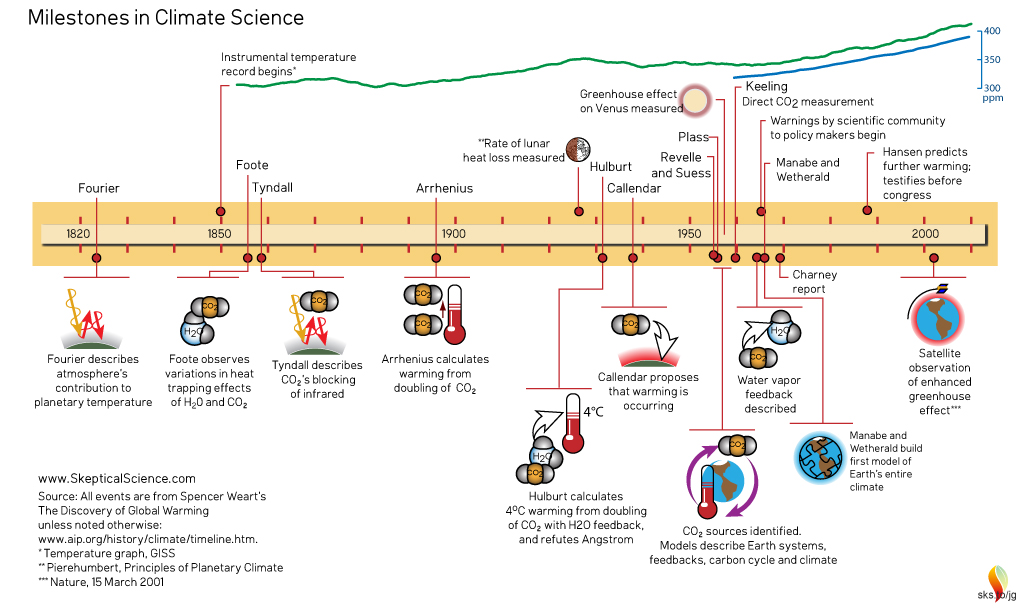
That’s very different from climate skeptics who often sound absolutely certain, even when they’re working from a few cherry‑picked studies or bits of data, or ideas that have been debunked. Scientists have been identifying the basics of climate change since 1824 (see image below)!
3. The loudest voices aren’t always the most reliable.
Some of the most confident, clear-cut messages come from climate deniers who present things like they’ve uncovered a big flaw in the science. But many of those voices are amplified—sometimes directly, sometimes indirectly—by groups with a lot to lose if the public takes climate change seriously. They often make it sound like science “backflipped,” when actually the core understanding has been consistent for decades. What has changed is the level of detail and the urgency, not the trend itself.
4. Why scientific consensus matters.
Individual scientists can be wrong, just like individual fishers can be wrong about where the fish are on a given day. But when thousands of independent studies from all over the world line up and say the same thing, that’s not an opinion anymore, that’s a consensus built on a huge amount of evidence. It’s the closest thing science has to a “sure bet.”
5. So why should you act on it?
Because acting early puts you, not the changes, in control. If you wait until every detail is nailed down, you risk being forced to react suddenly when conditions shift. It’s like preparing for rough weather: you don’t wait until the first wave comes over the bow before you get ready. Climate science and/or climate scientists aren’t trying to tell you how to run your business, but it is giving you the best information possible so you can make decisions that give you the best chance to protect your livelihood now and into the future.
Supporting gallery:
Answered by:

Prof Gretta Pecl
ANSWER 3
By: Dr Chloe Lucas‘Science’ – by which we mean using transparent, replicable methods of gathering information and analysis, and going through a stringent process of independent peer review – has long been considered a trustworthy process for finding factual evidence about environmental change. There are a couple of reasons why what is reported as science may not be trustworthy. One is that journalists may misunderstand, or selectively report, scientific data in order to write ‘clickable’ stories. The other is that misinformation, posing as science, can be spread by people with vested interests who may claim to be doing scientific research but are not. This is having a negative effect on the reputation of science. There are some ways to spot whether the reports you read are ‘good science’ or not. If you are reading about a scientific report, and you think it sounds questionable, search for the source – is it from a peer-reviewed article in a reputable mainstream scientific journal? Are the authors qualified experts in their field? If no report is cited, or the data cited are from a ‘thinktank’ or a source that may have vested interests, then you should treat it with caution.
Public trust in science is vital to ensure that decisions about how to manage the environment are made using the best available evidence. As the environment changes, and the technologies available to measure it change, scientific data will change to reflect this. This changeability over time is a reason to trust science, as the latest science represents the best evidence currently available. Recent research across 68 countries found that across the world, most people trust in the process of science and the integrity of scientists, with Australia having one of the highest levels of trust.
Answered by: