Keeping it cool: How Tasmania’s rock lobster fishers are preparing for marine heatwaves
- Adaptation story
- Tasmania
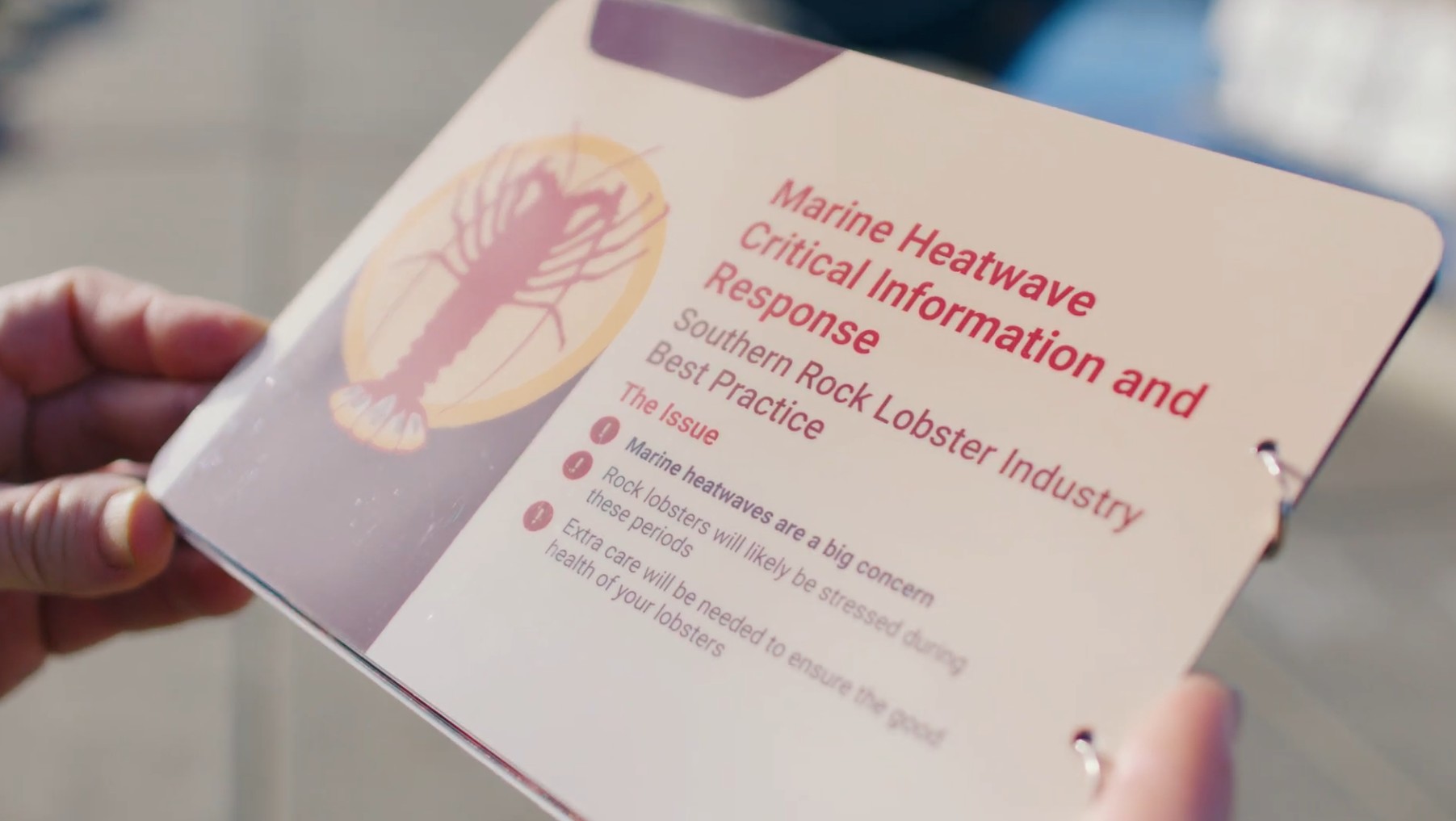
When Tasmania braces for a forecast marine heatwave, adaptation is already underway across the state’s lobster fleet.
Along the rugged coastline of Tasmania, where cool waters have long underpinned one of Australia’s most valuable fisheries, rising ocean temperatures are reshaping daily practice on deck. In response, the Tasmanian Rock Lobster Council Ltd is sharing a targeted video series to help fishers protect their catch, and their livelihoods, during extreme marine heatwave (MHW) events.
At the centre of the message is a simple principle: look after the water, and the lobsters will look after themselves.
For Southern Rock Lobster fishers, water quality is no longer just routine management – it is climate resilience in action. Onboard holding systems are now closely monitored with multiple temperature gauges, oxygen probes and flow alarms. As more lobsters are placed into tanks, oxygen levels drop, a risk amplified when ambient sea temperatures climb. During summer months, some fishers check dissolved oxygen three times a day, determined to ensure their lobsters arrive at market live and healthy despite warming seas.
The science backs up this vigilance. The Tasmanian Marine Heatwave and Related Event Response Plan identifies elevated water temperature, low dissolved oxygen and salinity fluctuations as key stressors during heatwave conditions. These factors can compound physiological stress in Southern Rock Lobster, increasing mortality risk if not carefully managed. Monitoring and rapid response, particularly overnight, when pump failures or oxygen crashes can go unnoticed, are critical safeguards.
Beyond onboard practices, the response plan encourages adaptive behaviours across the supply chain: reducing handling stress, avoiding unloading during the hottest part of the day, maintaining optimal tank flow rates, and adjusting stocking densities when temperatures spike. These small operational shifts can make the difference between survival and loss during prolonged warming events.
The Council is now considering showcasing the most climate-relevant segments of its best-practice videos – or compiling a targeted marine heatwave summary – to ensure fishers have rapid access to clear, practical guidance as summer unfolds.
This is adaptation in real time. Rather than waiting for crisis, Tasmania’s lobster industry is strengthening preparedness – improving monitoring, refining husbandry practices, and embedding climate awareness into everyday operations.
Marine heatwaves may be forecast, but their impacts are not inevitable. With careful water management – oxygen, temperature and salinity kept in balance – fishers are proving that resilience starts onboard. In a warming ocean, vigilance is becoming as valuable as the catch itself.
Funded by the Fisheries Research and Development Corporation, and in conjunction with the Tasmanian Rock Lobster Council Ltd and Institute for Marine and Antarctic Studies, the following series of best practice video guides.